Wednesday, December 07, 2005

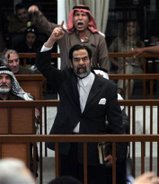
SADDAAM: "I am ready for your firing squad"

.
What is a Ramsey Clark to do?
خد
خدمات المواطنين
التسجيل لدى دائرة الهجرةمات المواطنين

Saddam Refuses to Attend Trial Arab News 22 hours ago -- Saddam Hussein refused to enter court for his trial yesterday, bringing the often chaotic proceedings to a halt before the judge decided to press on with the televised ...- 71 more stories .. (((send that man a package of fruit of the looms!)))

Good - bye SaaaaaaaD-DAMN!

Friday, December 02, 2005

ABOUT SEN. DORGAN: ("what was that? a democrat in the skybox? he was one of the investigators on the senate committee on indian affairs?)

. .
Senator Aided Abramoff Client, Used Skybox
By JOHN SOLOMON and SHARON THEIMER, Associated Press Writers -Fri Dec 2, 7:16 AM ET

WASHINGTON - The Democrat helping to lead the Senate investigation into Jack Abramoff's Indian lobbying had his own connections to the controversial lobbyist's team and clients, including using his sports arena skybox to raise money.

Sen. Byron Dorgan (news, bio, voting record), D-N.D., acknowledges he got Congress in fall 2003 to press government regulators to decide, after decades of delay, whether the Mashpee Wampanoag tribe of Massachusetts deserved federal recognition.

Dorgan met with the tribe's representatives and collected at least $11,500 in political donations from Abramoff partner Michael D. Smith, who was representing the Mashpee, around the time he helped craft the legislation, according to interviews and documents obtained by The Associated Press.

The senator also didn't reimburse another tribe, the Mississippi Choctaw, for the use of Abramoff's skybox in 2001, when the tribe held a fundraiser for him there, instead treating it as a tribal contribution. He only recently reimbursed the tribe for the box, four years later, after determining it was connected to Abramoff.

Dorgan, who is vice chairman of the Senate Indian Affairs Committee that is investigating Abramoff, says he sees no reason to step down from the probe, which he and Sen. John McCain,R-Ariz., are leading. He said he had no idea at the time that any of the transactions were connected to Abramoff or the alleged fleecing of tribes.

"I never met Jack Abramoff but I am appalled by what we have learned about his actions," Dorgan said Thursday. "So I have never felt there was any conflict in my helping to lead that investigation. I think Senator McCain would agree our investigation has been relentless and that neither of us will be diverted."

Dorgan's contacts, donations and fundraisers involving Abramoff tribal clients and lobbying associates, as well as those of other lawmakers, have not been examined during the Senate hearings into the lobbyist's roughly $80 million in charges to the tribes.

The senator didn't volunteer the information, although he did disclose his donations in campaign reports over the years.

Larry Noble, the government's former chief election enforcement lawyer, said Dorgan should have considered stepping aside from the inquiry and at the very least should have disclosed all his own intersections with Abramoff's associates and tactics.

"I think any way you look at it he had an obligation to disclose," Noble said. "It is hard for anyone not to see a conflict when you're investigating the same activity you yourself were involved with."

Over the last month, the AP has reported that about four dozen lawmakers, Republicans and Democrats, collected donations from Abramoff's tribal clients and firm around the time they wrote letters to the Bush administration or Congress favorable to the tribes.

Congressional ethics rules require lawmakers to avoid even the appearance of a conflict of interest in performing official duties and accepting political money. The Justice Department is investigating whether Abramoff, already charged with fraud in a Florida case, won any undue influence through donations and favors.

Dorgan on Monday sharply criticized the AP for reporting last week that he collected $20,000 from Abramoff's firm and tribes in the period when he wrote a letter urging the Senate Appropriations Committee to fund a school construction program that Abramoff's clients and other tribes wanted.

The senator, who has Indian tribes in his state, said he long supported the program, and the letter and donations had no connection. And he asserted that he never took any action or received any campaign help that knowingly involved Abramoff.

Dorgan, however, benefited from the very arena skybox that has become a symbol of Abramoff's controversial efforts to win Washington influence, records show.

The Mississippi Choctaw tribe, an Abramoff client that has been a primary focus of Senate hearings, sponsored a fundraiser March 28, 2001, for Dorgan's political group, the Great Plains Leadership Fund. The event treated Dorgan and his donors to a bird's-eye view of a professional hockey game from a skybox Abramoff leased in Washington's MCI Center, while lobbyists got the chance to bend his ear.

Dorgan knew the fundraiser was sponsored by the Choctaw and that two Abramoff lobbyists attended, but at the time he didn't know they were connected to Abramoff, his spokesman said. "He was told the skybox was the Choctaws'," Barry Piatt said.

Dorgan didn't reimburse the tribe, instead reporting the event as an "in-kind" $1,800 tribal contribution without specifying it involved the skybox.

Piatt said reporting it that way was legal and normal. The senator reimbursed the tribe $1,800 for the skybox earlier this year when he learned from reports that it was connected to Abramoff, Piatt said.

Documents the Senate released show Abramoff charged the Choctaws $223,679 to underwrite use of the skybox in 2001, the year of Dorgan's fundraiser, even though the tribe "very rarely" used it. Dorgan has denounced the fees as outrageous.

Dorgan and his staff met several times with Abramoff's lobbying team, according to the lobbying firm's billing records.

Smith, the Abramoff associate who represented both tribes and the Northern Mariana Islands, billed for at least four meetings with Dorgan or his staff in 2001. He billed for two hours on the day of Dorgan's skybox fundraiser for a discussion with the lawmaker on "minimum wage legislation," the records state.

Investigators have information suggesting Dorgan and his staff may have had more than 20 contacts with Abramoff's lobbying team involving the Marianas, tribes and other clients over the years, said a person directly familiar with the investigation who spoke only on condition of anonymity because of the probe continues. Piatt said Dorgan's office doesn't keep records of staff meetings but that any notations in billing records shouldn't be trusted because Abramoff was fired from his firm over his billing practices.

Dorgan's office acknowledged he met in 2003 with representatives of the Mashpee, the Massachusetts tribe that Abramoff signed as a client and Smith represented. The tribe was trying to persuade the federal government to rule on its decades-old request to be formally recognized.

The senator used his position as a member of the joint House-Senate committee that approved the final Interior Department spending bill for 2004 to craft a provision that pressed the agency to "complete its review of the Mashpee petition as expeditiously as possible."

"Absolutely, he was involved. The tribe asked him to be involved and the Massachusetts senators supported it," Piatt said. "They had 29 years of waiting. It seemed like a reasonable thing to do."

Piatt said he didn't think Dorgan's help was significant because the action didn't order Interior to make a specific conclusion, only urged it to act more quickly.

But the Mashpee say the lobbying paid off because Dorgan's provision prompted Interior to speed its decision-making process. The tribe credits Dorgan and one of his colleagues, Sen. Conrad Burns, R-Mont., another frequent recipient of Abramoff tribal donations, for the provision.

"Both Senator Burns and Senator Dorgan were helpful," Mashpee spokesman Scott Ferson said.
The summer before the help, Smith sent three donations to Dorgan totaling $1,500, while a separate Abramoff client, the Saginaw Chippewa, sent Dorgan a total of $10,000. The Saginaw were interested in a second provision in the same Interior spending bill, inserted by Burns, that provided the tribe $3 million in school construction money.


The spending bill was finalized Oct. 27, 2003, with both the Saginaw and Mashpee provisions.
Six weeks later, Smith donated $5,000 to North Dakota Senate 2004, a joint fundraising committee set up to help Dorgan's re-election. Smith made a second $5,000 donation to the same Dorgan committee in February 2004, campaign reports show.
___
On the Net:
Senate Indian Affairs Committee:
http://indian.senate.gov

###

The "glaucoma" of war, the Vietnam war, Mr. Rumsfeld, sir

.
Memorandum: to DoD Media Relations, (Larry DiRita)
From: Abbe Buck, HVPR
Question: After 40+ years, just more MSM-uber-liberal media commenting from a series of wire reports, or did any of this really happen? And is it happening now?

SEE: nation/world
Rationale for Vietnam faked in 1964, NSA historian wrote
From Wire Reports
Originally published December 2, 2005
WASHINGTON // A National Security Agency analysis released yesterday contends that an alleged 1964 attack on U.S. ships in the Gulf of Tonkin, which the Johnson administration cited as justification for greater U.S. military involvement in Vietnam, never happened, casting further doubt on the rationale for escalation of the conflict.The material posted on the Internet at midnight Wednesday included one of the largest collections of secret intercepted communications ever made available for study.
The most provocative document is a 2001 article in which an NSA historian argued that the agency's intelligence officers "deliberately skewed" the evidence passed on to policymakers on the crucial question of whether North Vietnamese ships attacked U.S. destroyers on Aug. 4, 1964.Based on the mistaken belief that such an attack had occurred, President Lyndon B. Johnson ordered airstrikes on North Vietnam, and Congress passed a broad resolution authorizing military action.The historian, Robert J. Hanyok, wrote the article in an internal publication, and it was classified as top secret despite the fact that it dealt with events in 1964. Word of Hanyok's findings leaked to historians outside the agency, who requested the article under the Freedom of Information Act in 2003.Some intelligence officials said they believe the article's release was delayed because the agency was wary of comparisons between the role of flawed intelligence during the Vietnam War and that preceding the U.S.-led invasion of Iraq.Hanyok declined to comment Wednesday. But Don Weber, an NSA spokesman, denied that any political consideration was involved."There was never a decision not to release the history" written by Hanyok, Weber said. On the contrary, he said, the release was delayed because the NSA wanted to make public the raw material that Hanyok used for his research."The goal here is to allow people to wade through all that information and draw their own conclusions," Weber said.Thomas S. Blanton, director of the National Security Archive at George Washington University, called the release of the document "terrific," noting that the eavesdropping material known as signals intelligence, or SIGINT, is the most secret information the government has."NSA may be the most close-mouthed of all U.S. government agencies," said Blanton, whose organization has published on the Web many collections of previously secret documents. "The release of such a large amount of SIGINT is unprecedented."In his 2001 article, an elaborate piece of detective work, Hanyok wrote that 90 percent of the intercepts of North Vietnamese communications relevant to the supposed Aug. 4, 1964, attack were omitted from the major agency documents going to policymakers."The overwhelming body of reports, if used, would have told the story that no attack had happened," he wrote. "So a conscious effort ensued to demonstrate that an attack occurred."Claims that North Vietnamese boats attacked two U.S. warships on Aug. 4 -- two days after an initial assault on one of the ships -- rallied Congress behind Johnson's buildup of the war. The Gulf of Tonkin Resolution passed three days later empowered him to take "all necessary steps" in the region and opened the way for large-scale commitment of U.S. forces.The Hanyok study does not necessarily reflect the agency's position."In truth, Hanoi's navy was engaged in nothing that night but the salvage of two of the boats damaged on 2 August," Hanyok wrote.He said that "the handful of SIGINT reports which suggested that an attack had occurred contained severe analytical errors, unexplained translation changes, and the conjunction of two unrelated messages into one translation. This latter product would become the Johnson administration's main proof of the Aug. 4 attack."Hanyok wrote that he did not find "manufactured evidence and collusion at all levels"; rather, it appeared that intelligence-gatherers had made a series of mistakes and that their superiors did not set the record straight.Conflicting and confused reports from the scene have long cast doubt on whether the events had unfolded as claimed.Hanyok's analysis of previously top secret intelligence adds insight on North Vietnam's communications from that time, showing, he said, that the supposed attackers did not even know the location of the destroyers, the USS Maddox and USS C. Turner Joy, as the two ships patrolled off the North Vietnamese coast.A shorter agency study done years earlier and also released yesterday indicated that the U.S. ships did not know what, if anything, was coming at them as they zigzagged to evade what the crews feared were torpedoes and as they fired on targets identified by radar.That study concluded with a wry note saying that the destroyers resumed their patrols after a heavy round of U.S. airstrikes on North Vietnamese ports, "and the rest is just painful history."A detailed chronology assembled days after the episode for the Joint Chiefs of Staff by J.J. Merrick, commander of Destroyer Division 192, reflected the uncertainty of that night.It said that sonar in many cases picked up sounds that were believed to be torpedoes but turned out to be "self noise," the beating of the ships' own propellers, or noise from patrol boats or supporting planes that were strafing the dark sea in cloudy skies, unable to see any prey.In another instance, however, the report contended that a "torpedo wake was seen by four people."The Maddox had been fired on by North Vietnamese patrol boats Aug. 2, 1964, suffering superficial damage.
Copyright © 2005,
The Baltimore Sun

###

Thursday, December 01, 2005

Well, DoD Public Affairs can and should do this, am I right? Why not? It's POSITIVE Feedback and good PR!

.
From the Los Angeles Times:
U.S. Military Covertly Pays to Run Stories in Iraqi Press----Troops write articles presented as news reports. Some officers object to the practice.
By Mark Mazzetti and Borzou Daragahi--Times Staff Writers
Published November 30, 2005

WASHINGTON — As part of an information offensive in Iraq, the U.S. military is secretly paying Iraqi newspapers to publish stories written by American troops in an effort to burnish the image of the U.S. mission in Iraq. The articles, written by U.S. military "information operations" troops, are translated into Arabic and placed in Baghdad newspapers with the help of a defense contractor, (The Lincoln Group) according to U.S. military officials and documents obtained by the Los Angeles Times.

Many of the articles are presented in the Iraqi press as unbiased news accounts written and reported by independent journalists. The stories trumpet the work of U.S. and Iraqi troops, denounce insurgents and tout U.S.-led efforts to rebuild the country.

Though the articles are basically factual, they present only one side of events and omit information that might reflect poorly on the U.S. or Iraqi governments, officials said. Records and interviews indicate that the U.S. has paid Iraqi newspapers to run dozens of such articles, with headlines such as "Iraqis Insist on Living Despite Terrorism," since the effort began this year.The operation is designed to mask any connection with the U.S. military. The Pentagon has a contract with a small Washington-based firm called Lincoln Group, which helps translate and place the stories. The Lincoln Group's Iraqi staff, or its subcontractors, sometimes pose as freelance reporters or advertising executives when they deliver the stories to Baghdad media outlets.

The military's effort to disseminate propaganda in the Iraqi media is taking place even as U.S. officials are pledging to promote democratic principles, political transparency and freedom of speech in a country emerging from decades of dictatorship and corruption. It comes as the State Department is training Iraqi reporters in basic journalism skills and Western media ethics, including one workshop titled "The Role of Press in a Democratic Society." Standards vary widely at Iraqi newspapers, many of which are shoestring operations. Underscoring the importance U.S. officials place on development of a Western-style media, Defense Secretary Donald H. Rumsfeld on Tuesday cited the proliferation of news organizations in Iraq as one of the country's great successes since the ouster of President Saddam Hussein.

The hundreds of newspapers, television stations and other "free media" offer a "relief valve" for the Iraqi public to debate the issues of their burgeoning democracy, Rumsfeld said. The military's information operations campaign has sparked a backlash among some senior military officers in Iraq and at the Pentagon who argue that attempts to subvert the news media could destroy the U.S. military's credibility in other nations and with the American public. "Here we are trying to create the principles of democracy in Iraq. Every speech we give in that country is about democracy. And we're breaking all the first principles of democracy when we're doing it," said a senior Pentagon official who opposes the practice of planting stories in the Iraqi media.

The arrangement with Lincoln Group is evidence of how far the Pentagon has moved to blur the traditional boundaries between military public affairs — the dissemination of factual information to the media — and psychological and information operations, which use propaganda and sometimes misleading information to advance the objectives of a military campaign. The Bush administration has come under criticism for distributing video and news stories in the United States without identifying the federal government as their source and for paying American journalists to promote administration policies, practices the Government Accountability Office has labeled "covert propaganda.

"Military officials familiar with the effort in Iraq said much of it was being directed by the "Information Operations Task Force" in Baghdad, part of the multinational corps headquarters commanded by Army Lt. Gen. John R. Vines. The officials spoke on condition of anonymity because they were critical of the effort and were not authorized to speak publicly about it.

A spokesman for Vines declined to comment for this article. A Lincoln Group spokesman also declined to comment. One of the military officials said that, as part of a psychological operations campaign that has intensified over the last year, the task force also had purchased an Iraqi newspaper and taken control of a radio station, and was using them to channel pro-American messages to the Iraqi public. Neither is identified as a military mouthpiece.The official would not disclose which newspaper and radio station are under U.S. control, saying that naming them would put their employees at risk of insurgent attacks. U.S. law forbids the military from carrying out psychological operations or planting propaganda through American media outlets. Yet several officials said that given the globalization of media driven by the Internet and the 24-hour news cycle, the Pentagon's efforts were carried out with the knowledge that coverage in the foreign press inevitably "bleeds" into the Western media and influences coverage in U.S. news outlets. "There is no longer any way to separate foreign media from domestic media. Those neat lines don't exist anymore," said one private contractor who does information operations work for the Pentagon.

Daniel Kuehl, an information operations expert at National Defense University at Ft. McNair in Washington, said that he did not believe that planting stories in Iraqi media was wrong. But he questioned whether the practice would help turn the Iraqi public against the insurgency. "I don't think that there's anything evil or morally wrong with it," he said. "I just question whether it's effective."
continue >>

Warner Seeks Military Response to Report It Paid Off Iraq Press
Bloomberg.com - Dec 01 2:25 PMDec. 1 (Bloomberg) -- Senator John Warner, chairman of the Senate Armed Services Committee, said he asked the Pentagon to respond to published reports that the U.S. military has covertly paid Iraqi newspapers to print pro-American stories.
###


Dec. 1 (Bloomberg) -- Senator John Warner, chairman of the Senate Armed Services Committee, said he asked the Pentagon to respond to published reports that the U.S. military has covertly paid Iraqi newspapers to print pro-American stories.

Warner, a Republican of Virginia, said in a statement that he has ``has no information to confirm or refute the report,'' and asked the Defense Department to brief the committee tomorrow on the issue.

The Los Angeles Times reported yesterday that stories written by ``information operation'' troops were secretly placed with media outlets in Iraq through a Washington-based defense contractor, Lincoln Group.

The stories are presented as unbiased news accounts written and reported by independent journalists, the paper reported. The articles praise the work of U.S. and Iraqi troops, denounce insurgents and commend U.S.-led efforts to rebuild the country.

In Baghdad, Major General Rick Lynch, chief military spokesman, said today the U.S. has a program to counter lies spread by terrorists in Iraq. Abu Musab al-Zarqawi, al-Qaeda's leader in Iraq, ``is continually lying to the Iraqi people, to the international community,'' Lynch said in a press briefing telecast from Baghdad.

``We do empower our operational commanders with the ability to inform the Iraqi public, but everything we do is based on fact not based on fiction,'' Lynch said.

Lincoln Group spokesman Laurie Adler, in a telephone interview, said the company ``can't discuss the contract but everything the Lincoln Group put out was truthful and factual.''

Information Omitted

The Los Angeles Times, in its report citing unnamed U.S. military officials, said that, while the articles are based on fact, they omit information that might reflect poorly on the U.S. or Iraqi governments. Dozens of such articles have run at a time when the U.S. government is pledging to promote free speech and democratic principles in Iraq, the paper said.

White House spokesman Scott McClellan today said the Bush administration is ``very concerned'' about the report.

``The United States is a leader when it comes to promoting and advocating a free and independent media around the world, and we will continue to do so,'' McClellan told reporters at a press briefing. ``We want to see what the facts are,'' he said.

Last Updated: December 1, 2005 17:18 EST

###